Bridging The Gap with AI
Bridging The Gap with AI
How language models collapse the distance between intent and outcome
Yassine Boumiza
An essay
Abstract. Every undertaking — a farm, a research lab, a ministry of finance, a classroom, a startup — lives inside a quiet arithmetic: the distance between what someone intends to do and what they are actually equipped to do. That distance is the gap. It is paid in hours of research no one has, in tacit knowledge locked inside specialists too busy to write it down, in coordination costs that scale faster than teams, in prototypes that never reach the fourth iteration because the third one exhausted the budget. For most of industrial history, the only way to narrow the gap was to hire someone who had already crossed it. Large language models change that relation. They do not remove the gap — the territory still has to be walked — but they radically reduce the cost of the walking. This paper argues that the defining economic and civic consequence of frontier AI is not the substitution of human labor, but the collapse of the frictional overhead that has historically kept competence expensive and coordinated action rare.
I. The Shape of the Gap
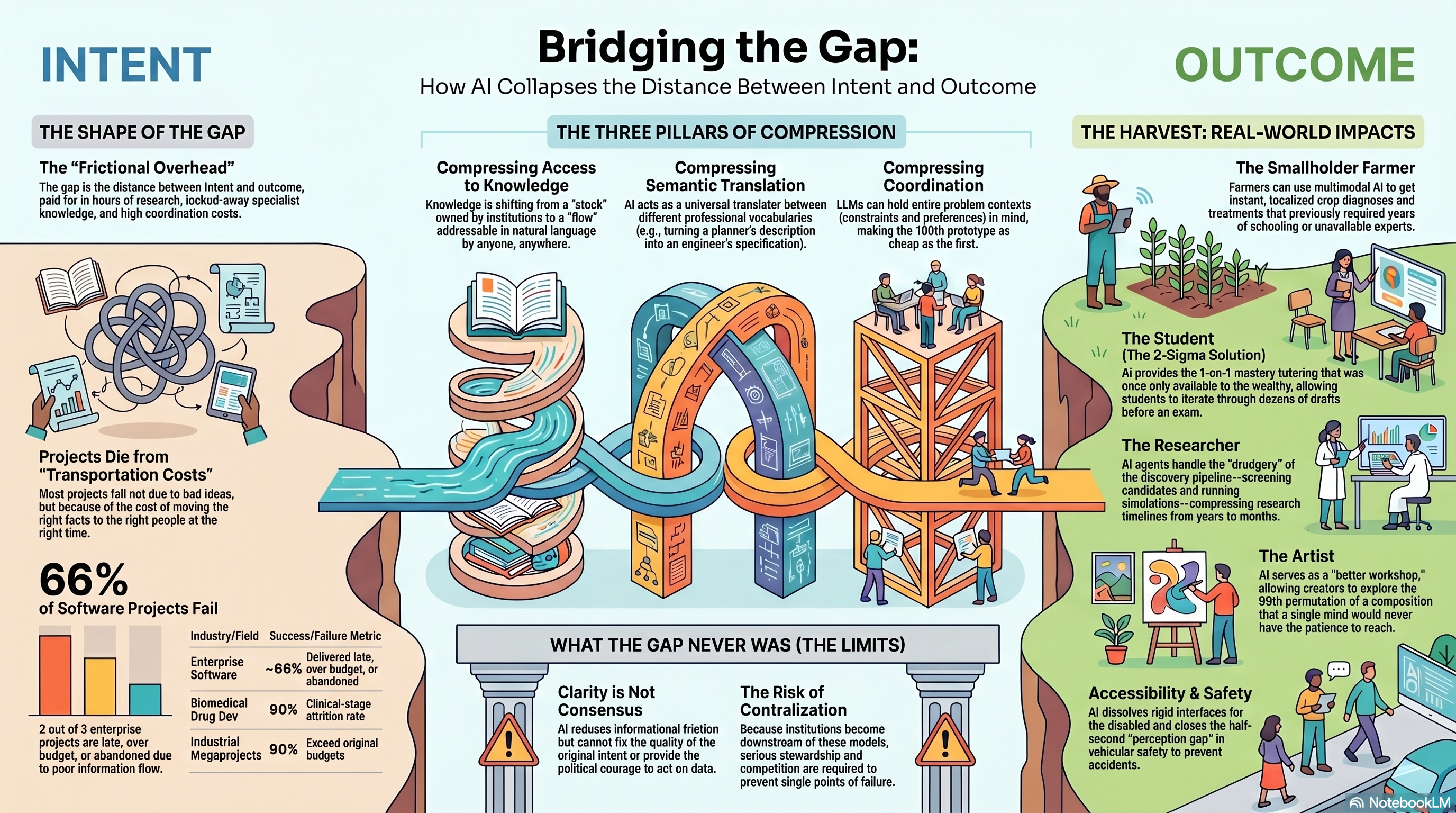
Ask any operator — a founder, a clinician, a deputy minister — why things move so slowly, and a version of the same answer tends to come back. The information exists, somewhere. The expertise exists, somewhere else. The people exist, in yet another place. The budget and the deadline exist under separate roofs entirely. Most of what kills projects is not bad ideas; it is the transportation cost of moving the right facts, to the right people, at the right time, in a form they can act on.
This transportation cost has a name in economics: transaction cost. Ronald Coase, in his 1937 paper The Nature of the Firm, argued that firms exist because the use of the price mechanism itself is costly — search, negotiation, measurement, enforcement — and that an internal hierarchy can sometimes perform the same coordination more cheaply. The logical extension is uncomfortable: if you could lower those coordination costs far enough, much of the scaffolding modern institutions carry on their books — the meetings, the memos, the status reports, the standing working groups — would become optional. A large share of what passes for knowledge work is really translation between departments, professions, and vocabularies.
For three decades, the Standish Group’s widely cited CHAOS report has tracked a stubborn pattern in enterprise software: somewhere around two out of three projects are either delivered late and over budget or are abandoned outright. Biomedical drug development is harsher still; pharmaceutical industry data place the clinical-stage attrition rate at roughly ninety percent, higher once one includes pre-clinical work. Bent Flyvbjerg’s tally of thousands of industrial megaprojects finds that nearly nine in ten exceed their original budgets, often by substantial margins. None of these are, at root, technical failures. They are failures of information flow, judgment, iteration, and coordination — the connective tissue, not the bones.
That is the gap.
II. What Frontier Models Actually Collapse
It is tempting to describe large language models by what they produce — essays, code, images, summaries. That framing misses the economic point. The more useful lens is what they compress.
They compress access to knowledge. A rural veterinarian no longer needs a subscription to three journals and a university contact to ask what an unfamiliar lesion on a goat might indicate. The answer, calibrated and hedged, can be in her hand in under a minute. Knowledge used to be a stock owned by institutions; it is becoming a flow, addressable in natural language.
They compress semantic translation. A municipal planner can describe a problem in the vocabulary of her profession and receive back a specification an engineer can build from, a legal memo an attorney can review, or a budget variance an auditor can sign off on. The translation layer that used to require a business analyst in the middle is increasingly free, and it is available at three in the morning.
They compress coordination. Frontier models can hold an entire problem in context — requirements, constraints, stakeholder preferences, prior attempts — and advance it incrementally. The first prototype is no longer the expensive one; the hundredth is. This inverts the economics of iteration, and iteration is where most real work gets done.

To a first approximation, a frontier LLM is a universal reduction in the cost of being informed, of being understood, and of being coordinated. Every domain that has been bottlenecked by any of those three is about to re-price.
III. The Harvest
The abstract argument is easier to believe when you watch it land in specific fields. What follows are not futurist projections; each is happening now, unevenly, in pockets scattered across continents.

The smallholder farmer. Public extension services — the infrastructure that once placed an agronomist in every county — have been hollowed out for a generation in most of the world. A farmer who sees a strange mottling on a tomato leaf has historically had three options: guess, call a neighbor, or lose the crop. Today, a photograph uploaded to a multimodal model returns not only a probable diagnosis — late blight, bacterial spot, tomato yellow leaf curl virus — but a ranked list of culturally and economically appropriate treatments, the dosage, the withdrawal period, and the likelihood of re-infection given the regional climate. The farmer did not need to know that Phytophthora infestans existed. He needed a cure that worked by Thursday. The gap between his problem and the world’s accumulated plant-pathology literature used to be measured in years of schooling he could not afford. It is now measured in seconds.
The artist. A common misreading of generative models is that they threaten creative work by producing it. The working artists I know tell a different story. The raw material of creative work is not the first idea; it is the tenth, the fiftieth, the variant that emerges after you have exhausted your defaults. AI is useful to them not because it is creative — it is not, in the strong sense — but because it is patient. It will produce the ninety-ninth permutation of a composition, a palette, a chord progression, a stanza, without tiring, and hand the artist back a wider search space than any single mind can hold. The result is not automated art. It is a craftsperson with a better workshop, and the branch of the tree she would never have reached on her own.
The researcher. Whether the object of inquiry is a molecule, a material, or a machine-learning architecture, the bottleneck of research has never been the first hypothesis; it is the fourth and the fortieth, each of which requires designing an experiment, setting parameters, running the trial, reading the result, and deciding what to change. An LLM-driven agent given a well-specified objective — a yield above a threshold, a toxicity below one, a loss curve that flattens — can pilot a simulator or a lab robot through that loop without the principal investigator being in the room for each step. The human retains the prerogative that actually matters: what counts as a good outcome. The agent absorbs the drudgery between hypotheses. This is why specific stages of the discovery pipeline — target identification, candidate screening, protein structure inference — have begun to compress from years into months, even as the end-to-end regulatory clock remains long.
The government. A finance ministry preparing a budget is attempting, in the best case, to reason about second- and third-order effects across every line item — the elasticity of a duty, the multiplier of a transfer, the employment consequence of a tariff. The classical way to do this is to hire a large forecasting team and accept that large parts of the budget will be reasoned about by analogy rather than analysis. A well-instrumented AI system, fed the plan and the relevant data, can surface the blind spots: subsidies whose beneficiaries have quietly changed, revenue projections whose underlying base has eroded, expenditures whose real-terms value has been hollowed out by inflation, transfers that look progressive on paper and regressive in effect. It does not replace the minister’s judgment. It raises the quality of the questions the minister has to answer before signing.

The student. For two centuries, the dominant bottleneck in learning has been feedback. A student can read for eight hours, but the single most effective hour is the one in which a tutor tells her what she got wrong and why. Benjamin Bloom’s 1984 paper on what he called the “two-sigma problem” reported that students taught one-to-one by a tutor, using mastery-learning techniques, performed about two standard deviations above students in conventional classrooms — an enormous effect that has never been replicated at scale because the labor economics did not permit it. They now can. A student preparing for an exam can generate every variant of every likely question, attempt them, be corrected with patience, and walk into the actual exam as the eleventh draft rather than the first. This is not cheating. It is what wealthy households have paid for privately since the Victorian era, generalized.
Accessibility. A significant fraction of the population cannot use a keyboard comfortably, cannot see a screen at all, or cannot easily parse written prose. The earlier generation of assistive technology was expensive, narrow, and unforgiving — a screen reader that choked on a poorly tagged PDF, a dictation tool that misrecognized one word in six, a terminal no one without a computer-science degree could negotiate. A multimodal model that can see, hear, read, and speak at near-human fluency dissolves most of those interfaces. The computer, for the first time in its history, meets the user where she already is, in the language and modality she already uses. It is the quiet civil-rights story of the decade.
Vehicular safety. The World Health Organization’s Global Status Report on Road Safety identifies road traffic injuries as the leading cause of death for people aged five to twenty-nine. The operational question of autonomous driving has, for a decade, been framed as: can a machine drive better than a human? The more useful question is narrower and more answerable: can a machine, embedded across cars, trucks, buses, and bikes, anticipate the subset of situations — the child running between parked cars, the truck whose brake lights have failed, the cyclist in the blind spot, the drunk driver approaching a blind intersection — where a human’s reaction time is the binding constraint? The evidence from mandated-AEB fleets and insurance-loss data is increasingly that it can. Driver assistance does not need to replace the driver to save lives; it needs to close the half-second gap between perception and response. That half-second is, in the accident statistics, often the difference between a near miss and a funeral.
IV. What the Gap Never Was
A responsible reading of AI’s promise requires acknowledging what it does not fix. The gap between intent and outcome has three layers. AI collapses the outermost — informational and coordinational friction. It does not collapse the middle layer, which is the quality of the intent itself, nor the innermost, which is the ethical and political question of whose intent gets to shape whose life.
A farmer with a better diagnosis still needs a supply chain that can deliver the right fungicide at a price he can pay. A student with infinite tutoring still needs a credential the labor market will honor. A ministry with sharper budget analysis still needs the political will to act on it. AI lowers the cost of clarity; clarity is not the same as consensus, and consensus is not the same as courage.

There is also the risk that a technology this compressive in nature concentrates power in the small number of organizations that build it. The same property that puts a broadly capable tool in the hands of a veterinarian in rural Tunisia makes every institution downstream of a frontier model reliant on infrastructure it does not control. Serious stewardship — meaningful competition at the frontier, independent evaluations, open weights where they can be safely released, and procurement rules that refuse single points of failure — is not a moral garnish on the technology. It is a condition of the distribution of benefits this paper has argued for.
V. Closing
The industrial revolution was a story about the cost of physical work falling by an order of magnitude or more across the leading sectors of the nineteenth-century economy. Its consequences — cities, nation-states, the modern middle class, the welfare apparatus — took a century to work themselves out, and were neither obvious nor uniformly benign at the time. The AI transition, if the argument of this paper is right, is a story about the cost of cognitive coordination falling on a similar order. Its consequences will also take time to work themselves out, and will also not be obvious or uniformly benign.
What is clear, even now, is the direction. The person at the far end of every institutional chain — the farmer, the student, the patient, the citizen, the driver, the person who cannot type on a keyboard — has been waiting a long time for the expertise at the other end to reach her. For most of human history, it did not. It is starting to.
The gap is not closed. But for the first time, it is being bridged.
References
Bloom, B. S. (1984). The 2 Sigma Problem: The Search for Methods of Group Instruction as Effective as One-to-One Tutoring. Educational Researcher, 13(6), 4–16.
Coase, R. H. (1937). The Nature of the Firm. Economica, 4(16), 386–405.
Flyvbjerg, B. (2014). What You Should Know About Megaprojects and Why: An Overview. Project Management Journal, 45(2), 6–19.
Paul, S. M., Mytelka, D. S., Dunwiddie, C. T., Persinger, C. C., Munos, B. H., Lindborg, S. R., & Schacht, A. L. (2010). How to Improve R&D Productivity: The Pharmaceutical Industry's Grand Challenge. Nature Reviews Drug Discovery, 9(3), 203–214.
Standish Group International. CHAOS Report (annual series, 1994–present). Boston: Standish Group.
World Health Organization. (2023). Global Status Report on Road Safety 2023. Geneva: WHO.