
The Other Side of the Bridge
The Other Side of the Bridge
AI, the K-Shaped Economy, and the Politics of Who Gets to Cross
Yassine Boumiza
A companion essay to “Bridging The Gap with AI”
Abstract. The companion paper to this one argued that frontier AI is collapsing the informational, semantic, and coordinational friction that has historically kept competence expensive. Granting that, one question remains, and it is the question that decides whether the technology is a civic good or a private one: for whom? A tool that lowers the cost of assembling expertise does not, by itself, distribute that expertise evenly. It is as easy to imagine AI widening the K-shaped fracture of the modern economy — one arm rising, one arm falling — as narrowing it. This essay argues that the outcome is not a property of the technology but of the infrastructure, institutional design, and political choices around it, and sketches the specific conditions under which AI becomes a leveler rather than an accelerant of inequality.
I. A K, Not a V

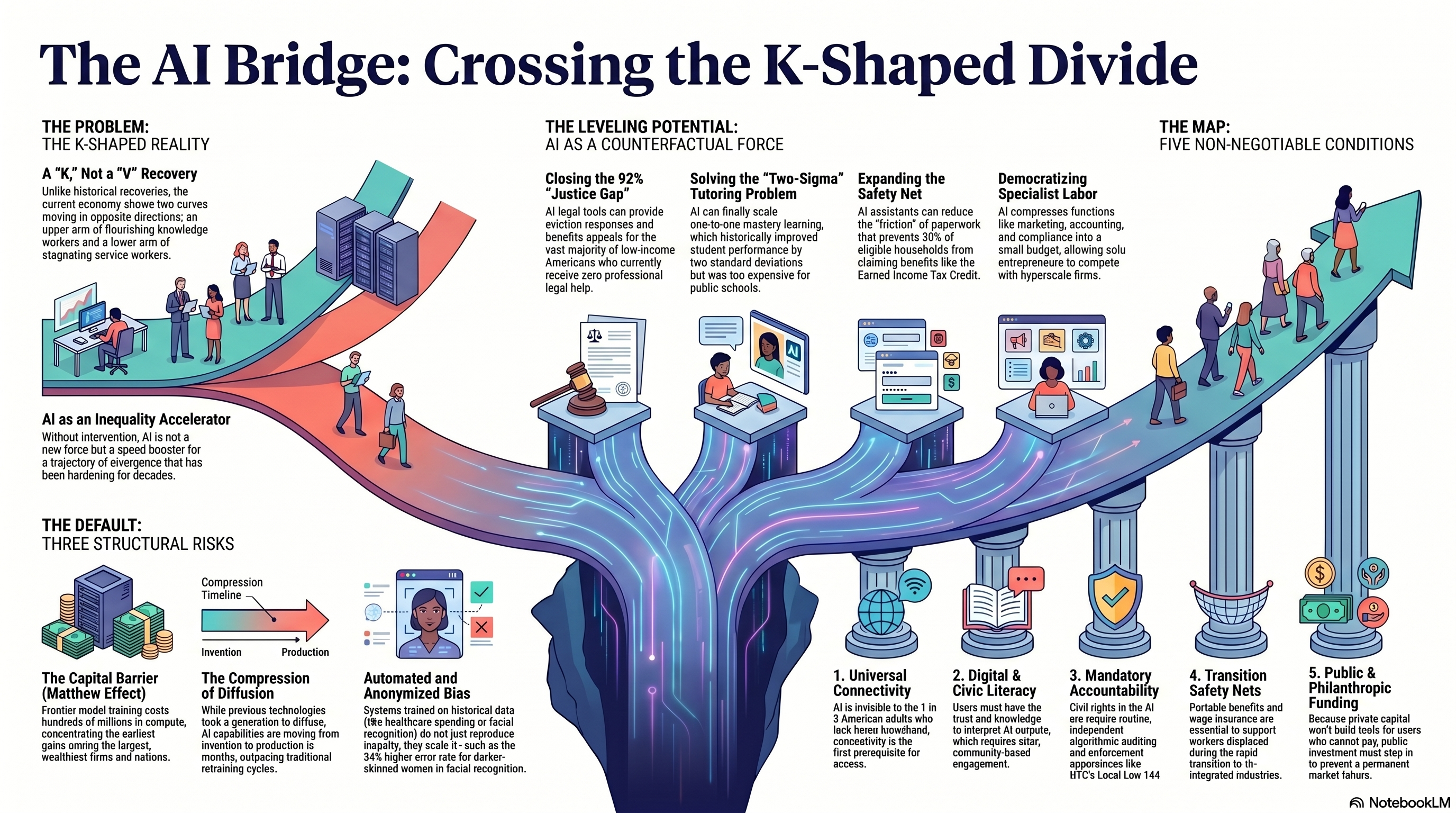
The economic recoveries of the twentieth century tended to be described in letters, and most of the letters were reassuring. A V-shaped recession fell sharply and came back. A U took longer. An L signaled stagnation. The shape that emerged from the 2020 pandemic and has arguably hardened since is a K, and the K is different in kind. It is not a shape about the speed of recovery but about who recovered. The upper arm — knowledge workers with remote-compatible jobs, asset holders, the professional-managerial class — did better than they had been doing before. The lower arm — in-person service workers, people in disrupted industries, households in communities that had already fallen behind on broadband and transit and housing — did worse. Two curves, one country, opposite directions.
That divergence did not begin with the pandemic. Stagnant median wages, the collapse of private-sector unions, the hollowing-out of routine-cognitive jobs, and the concentration of asset appreciation all predate COVID by decades. What is new is the velocity. The arms of the K are separating faster than the institutions built to narrow them can respond. AI enters this picture not as a new force but as an accelerator of a trajectory already underway — and whether it accelerates the separation or begins to reverse it is, so far, undetermined.
II. The Default

The default expectation, absent deliberate intervention, is that AI deepens the divide. There are three reasons for this, and each of them is structural rather than ideological.
The first is capital. Training a frontier model costs on the order of hundreds of millions of dollars in compute alone, and deploying it at scale requires a software stack, a data pipeline, and an organizational readiness that are overwhelmingly concentrated among large firms in rich countries. The early returns to AI therefore accrue to organizations that were already winning — a classic Matthew effect in the economics of technology.
The second is speed. Every previous general-purpose technology — electrification, the personal computer, the internet — took a generation to diffuse. Workers displaced by one wave had time, institutionally and biographically, to be retrained for the next. The diffusion curve of frontier AI is being measured in months, not years. The window between a capability existing and being incorporated into a production system is now narrower than the retraining cycle of most public education infrastructure. That compression favors workers who are already adjacent to AI and penalizes workers who are not.
The third is bias, embedded in training data. Ziad Obermeyer and colleagues showed in 2019, in a paper that should be required reading for every AI product team, that a widely used healthcare-management algorithm systematically under-referred Black patients for specialty care — not because anyone programmed it to, but because it used historical healthcare spending as a proxy for need, and historical healthcare spending was already unequal. Joy Buolamwini and Timnit Gebru’s Gender Shades study found error rates for commercial facial-recognition systems on darker-skinned women up to thirty-four percentage points higher than on lighter-skinned men. When an AI system inherits the fingerprint of a historical inequity, it does not merely reproduce the inequity; it automates and anonymizes it at scale, which is worse.
That is the default. It is not malicious. It is what happens when a compressive technology is released into a system that was already unequal.
III. The Counterfactual

But this is not the only possible trajectory, and the reason is that frontier AI has a property almost unique among general-purpose technologies: the marginal cost of delivering it to an additional user is close to zero, and the marginal quality of the output does not visibly degrade with scale. A lawyer can serve perhaps two hundred clients a year. A language model can serve two hundred million. That property has distributional implications that deserve to be taken seriously.
Consider the access gap in professional services. The Legal Services Corporation’s 2022 Justice Gap report estimated that ninety-two percent of the substantial civil legal problems faced by low-income Americans receive no or inadequate legal help. The issue is not that the law is unknowable; it is that human lawyers are rationed by price. AI legal tools now draft eviction responses, dispute notices, benefits appeals, and immigration forms at a fraction of the cost. They do not replace the lawyer that a complex case requires, but they close the bottom of the distribution — the ninety-two percent who currently receive nothing.
Consider education. Benjamin Bloom’s 1984 paper on the “two-sigma problem” reported that students taught one-to-one by a tutor, using mastery-learning techniques, performed about two standard deviations above students in conventional classrooms. The effect size is almost unprecedented in education research, and it has not been reproduced at population scale because the labor economics of one-to-one tutoring never permitted it. They now can. The students who stand to gain the most are precisely those whose schools currently cannot afford to hire tutors of any kind — the inverse of the historical pattern in which new educational technology was first adopted by private schools.
Consider the unclaimed-benefits problem. Saurabh Bhargava and Dayanand Manoli showed in their 2015 American Economic Review paper on the Earned Income Tax Credit that roughly one in five eligible households fails to claim the benefit — leaving billions of dollars on the table annually. Participation in the Supplemental Nutrition Assistance Program is similarly imperfect, with roughly eighteen percent of eligible households not enrolled. The reason is not stinginess; it is friction — paperwork, eligibility confusion, documentation demands, time off work to file. An AI system that can intake a family’s circumstances in natural language, cross-reference the dozens of programs they might qualify for, and walk them through the application forms replaces precisely the kind of professional labor that working parents cannot afford to hire. The safety net, for the first time, can catch people at the bottom of the K rather than at the middle.
Consider the small business. The entrepreneur in an underbanked community competes against larger firms with specialists in marketing, accounting, compliance, legal, and customer service. AI compresses several of those specialist functions into a small operating budget. This does not erase the advantages of scale — a hyperscaler will always be able to invest more — but it makes entrepreneurship more feasible for people without a professional network or inherited capital, which happens to be a reasonably precise description of the lower arm of the K.
Consider healthcare. The inequality is not primarily one of medical knowledge; it is one of attention. The wealthy have concierge medicine, which is just medicine with enough time. Lower-income patients have whatever they can extract from fifteen-minute primary care visits scheduled months apart. AI-enabled remote monitoring, triage, and follow-up do not replace clinicians, but they redistribute the scarce resource — attention — toward people who currently receive almost none of it.
None of these are speculative. Each is happening today, in patches, at varying degrees of maturity.
IV. The Conditions

A technology with leveling potential does not level by itself. The history of general-purpose technologies — electricity, sanitation, the automobile, the personal computer — is that the benefits reach the bottom of the distribution only when public infrastructure, regulation, and deliberate subsidy are built to make them. Five conditions seem to me non-negotiable.
The first is connectivity. None of the applications described above work if the user cannot reach them. The 2021 Pew Research Center data on home broadband show that roughly one in five American adults does not have a home broadband subscription, and the gap is sharply correlated with income, rurality, and race. AI without broadband is, for the excluded household, indistinguishable from AI that does not exist.
The second is literacy — digital and civic. A tool that asks a patient to describe symptoms in natural language presupposes that she trusts the tool enough to be candid, understands enough to interpret the answer, and recognizes the limits of what it tells her. Trust is not a policy lever; it is built over years through community engagement, and it is destroyed quickly by a single high-profile misuse. That makes it the slowest variable in the system.
The third is accountability. The Obermeyer and Buolamwini–Gebru results are only two cases in a large and growing literature on algorithmic harm. Routine, independent, legally mandated algorithmic auditing is the civil-rights infrastructure of the AI era, and it barely exists. New York City’s Local Law 144, which requires bias audits of automated employment-decision tools, and the European Union’s AI Act provisions on high-risk systems are first steps; the enforcement apparatus around them is, as of this writing, thin.
The fourth is the safety net for those displaced during the transition. Even a technology that eventually raises the whole curve will cost some workers their livelihoods along the way, and the distribution of that cost is a political choice rather than a natural fact. Portable benefits, meaningful retraining programs, and wage insurance during transitions are not anti-AI policy; they are what makes pro-AI policy politically sustainable.
The fifth is public and philanthropic funding for applications that serve communities who cannot pay market prices. Private capital will not build an AI tool to help Medicaid recipients navigate benefits, because the willingness-to-pay of that user is zero. That is the textbook definition of a market failure — the kind public investment exists to correct.
V. Closing
The companion essay to this one argued that frontier AI is collapsing the cost of cognitive coordination. This one argues that the consequence of that collapse — whether it narrows the K or widens it — is not a property of the technology but of the society receiving it.
The technology itself is neutral in the trivial sense that any tool is neutral, and in no other sense that matters. A bridge that can only be crossed by people who already hold a passport is not a bridge in the civic sense. It is a toll road. What determines the difference is not the engineering of the arch; it is the politics of who gets to walk across it.
The gap is being bridged. Whether it is bridged for everyone is the next decade’s argument.
References
Bhargava, S., & Manoli, D. (2015). Psychological Frictions and the Incomplete Take-Up of Social Benefits: Evidence from an IRS Field Experiment. American Economic Review, 105(11), 3489–3529.
Bloom, B. S. (1984). The 2 Sigma Problem: The Search for Methods of Group Instruction as Effective as One-to-One Tutoring. Educational Researcher, 13(6), 4–16.
Buolamwini, J., & Gebru, T. (2018). Gender Shades: Intersectional Accuracy Disparities in Commercial Gender Classification. Proceedings of Machine Learning Research, 81, 77–91.
Legal Services Corporation. (2022). The Justice Gap: The Unmet Civil Legal Needs of Low-Income Americans. Washington, DC: LSC.
Obermeyer, Z., Powers, B., Vogeli, C., & Mullainathan, S. (2019). Dissecting Racial Bias in an Algorithm Used to Manage the Health of Populations. Science, 366(6464), 447–453.
Pew Research Center. (2021). Internet/Broadband Fact Sheet. Washington, DC: Pew Research Center.
U.S. Department of Agriculture, Food and Nutrition Service. Trends in Supplemental Nutrition Assistance Program Participation Rates (annual series).
Companion essay: “Bridging The Gap with AI — How Frontier Language Models Are Collapsing the Distance Between Intent and Outcome.”